
Rack Planning
Display Rack vs Storage Rack: What Is the Difference?
A practical comparison of display racks and storage racks, including where each should be used in shops, supermarkets, warehouses and industrial spaces.
Display racks are designed for selling
A display rack is built for areas where customers see, compare and pick products. Its job is not only to hold stock, but also to make products look organized and easy to buy. In a retail store, a display rack affects how quickly customers understand categories, how easily staff can refill products and how professional the shop feels. That is why display racks often focus on clean finish, correct height, shelf visibility, aisle presentation and product access.
Display racks are common in supermarkets, grocery stores, pharmacies, garment shops, electronics stores, hardware showrooms and general retail outlets. They may be wall mounted, freestanding, center gondola style, end-cap style or custom-built for a product category. A well-made display rack keeps heavier items at safer lower levels, keeps fast-moving products within easy reach and gives the store a consistent visual rhythm. When display racks are planned properly, the store looks more spacious and customers spend less effort finding what they need.
Storage racks are designed for capacity
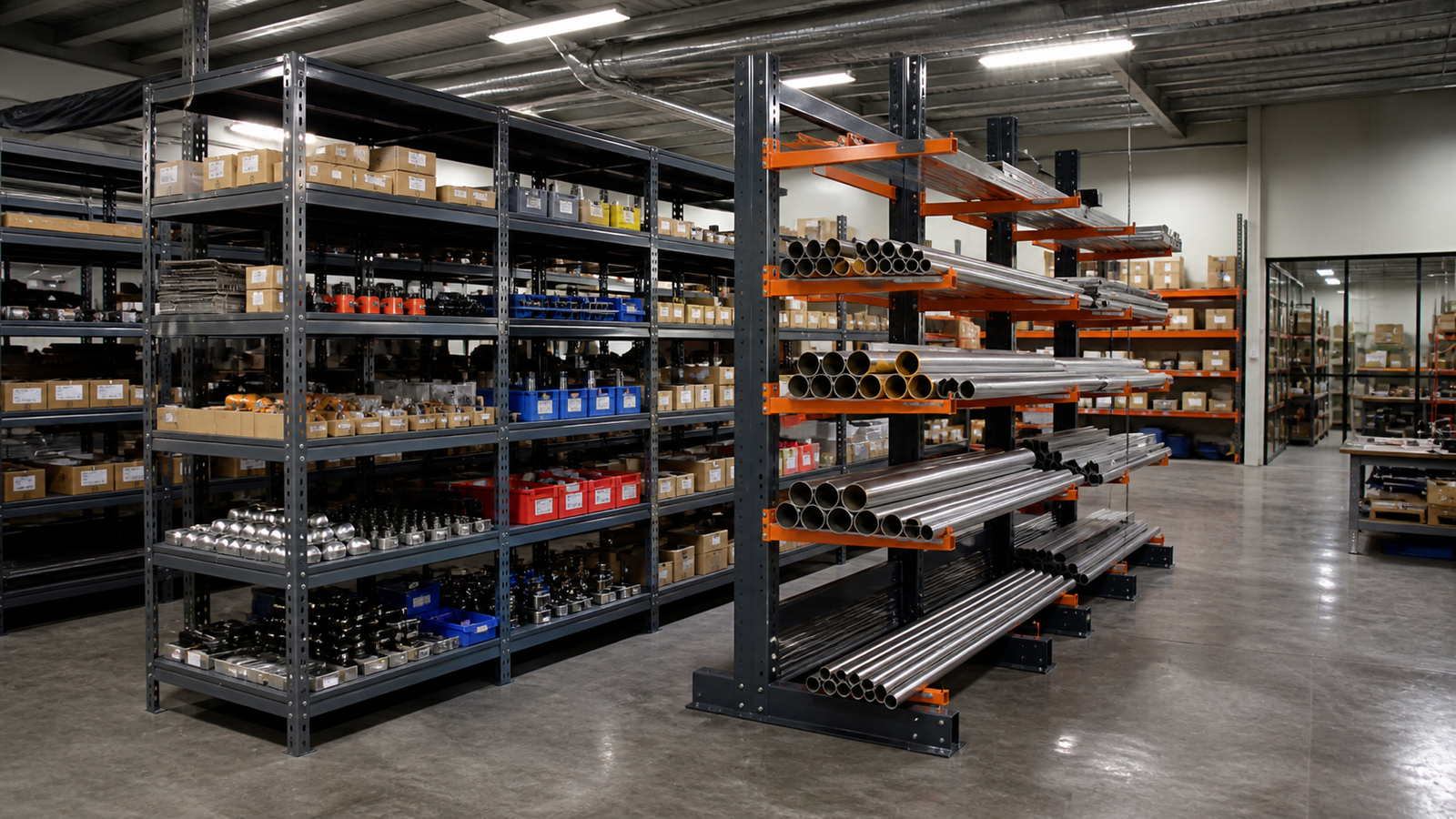
A storage rack is built for back-end organization, load capacity and repeated handling. It may be used in a stock room, warehouse, workshop, office record room, factory store or industrial inventory area. Customers may never see it, but staff rely on it every day. For storage racks, the key questions are different: how much weight will each shelf hold, how often will items be removed, how wide should each bay be, and how much expansion may be required later.
Slotted angle racks, heavy-duty racks, pipe racks, partition racks and warehouse racks fall into this category. The finish still matters, but performance matters more. A storage rack should not bend under load, should allow easy labeling, should keep aisles clear and should make inventory retrieval faster. If a business handles cartons, tools, machine parts, files or industrial material, storage racks often save more time than they cost because staff stop wasting time searching through piles or shifting unstable stacks.
Some shops need both systems
Many businesses make the mistake of using display racks as storage racks or storage racks as display racks. A display rack overloaded with cartons begins to look messy and may not handle the weight. A storage rack placed in the customer area may be strong, but it can make the shop look unfinished. The best solution is usually a combination: display racks for the sales floor and stronger storage racks for stock handling behind the scenes.
For example, a pharmacy needs clean customer-facing counters and medicine display cabinets, but it may also need back-room storage for cartons and refill stock. A supermarket needs gondola racks for aisles, but bulk inventory may require warehouse-style racks. A hardware business needs front display for frequently purchased tools and stronger storage for heavy or odd-sized items. Separating display and storage functions makes the business easier to operate.
How to choose between them
Choose a display rack when the rack will influence customer experience. Ask whether products need front visibility, whether the rack height should feel comfortable, whether branding colors matter and whether the unit should support hooks, baskets or shelves. Choose a storage rack when the rack will mainly serve staff and inventory. Ask about load, shelf spacing, labeling, access, floor strength and expansion. The decision becomes simple when you focus on the daily job of the rack.
If a single area must do both jobs, design the rack carefully. Strong lower shelves can hold heavier stock while upper shelves display lighter items. Partitions can separate categories. Adjustable shelves can support product changes. A good manufacturer will not simply ask how many racks you want; they will ask what the racks are expected to do. That conversation is what turns steel into a useful business system.
Indore businesses should think locally
For businesses in Indore, local manufacturing has a practical advantage. Measurements can be discussed more easily, custom sizes can be planned according to the actual shop, and future additions can match the existing setup. If a rack needs adjustment, extra shelves or a matching counter later, working with a nearby manufacturer is often simpler than buying a generic unit from far away.
The right mix of display racks and storage racks improves both presentation and operations. Customers see a cleaner store, staff work faster, stock remains safer and the owner gets better use of available space. Before buying, walk through the store as both a customer and a staff member. Wherever the customer experience matters, think display. Wherever capacity and retrieval matter, think storage.
Compare examples before choosing
A grocery store may use display racks on the sales floor and storage racks in the back room. A pharmacy may use display cabinets for medicine categories, a counter for billing and storage racks for sealed cartons. A hardware store may need front-facing display for tools, drawer cabinets for smaller parts and heavier racks for boxes or industrial items. These examples show why one rack name is rarely enough. The business should be divided into zones, and each zone should get the rack that suits its job.
When you look at rack photos, ask what problem each rack is solving. Is it improving customer visibility, increasing stock capacity, organizing parts, separating categories or supporting heavy material? This habit makes it easier to choose correctly. It also helps you explain your requirement to a manufacturer without getting lost in technical terms.
Think about staff habits
A rack layout only works if staff can use it consistently. If shelves are too high, too deep or poorly labeled, staff will avoid using them properly. If the display area has no space for refill stock, products may end up on the floor or counter. If storage racks are overloaded because categories are unclear, the system slowly breaks down. Good rack planning supports good habits.
For display racks, staff should be able to refill quickly and keep products aligned. For storage racks, staff should know exactly where each category belongs. This is where partitions, labels, adjustable shelves and logical bay sizes become valuable. The rack should make daily discipline easier, not harder.
Do not ignore appearance in storage areas
Storage racks are not always visible to customers, but appearance still matters. A clean, well-organized stock room helps staff work with more confidence and reduces errors. It also creates a better impression when suppliers, partners or customers see behind-the-scenes areas. A messy storage area can hide expired stock, damaged products or duplicate purchases.
A consistent finish, safe edges, proper shelf alignment and enough aisle space make the business feel better managed. Even when the main purpose is capacity, a storage rack should still support order and cleanliness. In the long run, this improves inventory control and reduces wasted time.
Final checklist before deciding
Before deciding between a display rack and a storage rack, ask where the rack will be used, who will interact with it and what outcome matters most. If customers will see the rack, appearance, category clarity and product access are important. If staff will use it for inventory, strength, labeling and retrieval speed are more important. If the same area needs both, the rack should be designed as a hybrid instead of forcing one standard model into every job.
Also think about the next year, not only the first installation. Display areas may need new accessories, changed shelf heights or extra bays. Storage areas may need more load capacity, partitions or expansion. A thoughtful first design keeps those changes easier. That is why the best rack decision is not display versus storage as a simple choice; it is a plan for how each part of the business should function.
When speaking with a manufacturer, describe the customer-facing areas separately from the staff-only areas. Explain which products need to look premium, which products are heavy, which products move quickly and which products only need organized storage. This helps the manufacturer suggest a practical mix instead of giving one standard rack for every space. A good rack plan should make the sales floor more attractive and the back-end operation more disciplined.
If you are replacing old racks, note what failed. Maybe shelves bent, aisles became crowded, products were hard to see or stock was difficult to count. These problems are useful clues. The new system should solve them directly. Better rack planning is not only about buying new steel; it is about removing the friction that slowed the business earlier.
What a good final layout feels like
A good final layout feels obvious after it is installed. Customers can see products clearly, staff know where stock belongs, and the owner can add or remove inventory without disturbing the whole system. Display racks make the front area look intentional, while storage racks keep extra material controlled behind the scenes. The two systems support each other instead of competing for space.
If the layout needs constant explanation, it probably needs adjustment. Strong rack planning should reduce confusion. Products should have natural homes, aisles should remain usable, and heavy stock should not create daily handling problems. This is the real difference between simply buying racks and designing a rack system for a business.